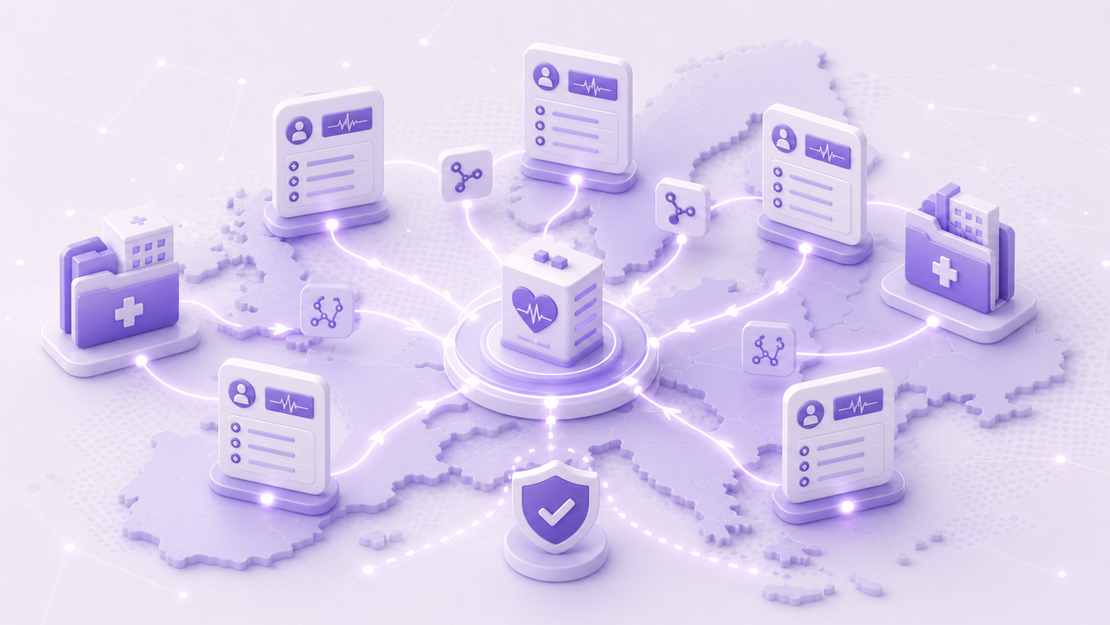
EHDS and Interoperability: Why Europe Is Standardising the EHR Market
- Tomasz Kulbacki
- Ehds , Interoperability
- May 12, 2026
Table of Contents
Chapter III of Regulation (EU) 2025/327 fundamentally changes how interoperability is regulated in the European healthcare ecosystem.
Historically, interoperability was often treated as a procurement requirement, a voluntary standard, or a best-effort integration challenge.
EHDS transforms interoperability into a regulatory obligation directly linked to market access.
The regulation introduces harmonised software components, common interoperability specifications, mandatory logging capabilities, testing environments, CE-related obligations, and technical compliance expectations for EHR systems.
This publication explains how EHDS effectively creates a European interoperability framework for EHR vendors, healthcare providers, digital health platforms, medical device manufacturers, and AI systems interacting with health data.
The article also analyses the relationship between EHDS and MDR, IVDR, and the AI Act.
A particularly important development is the emergence of interoperability as a compliance requirement.
Under EHDS, technical architecture increasingly determines legal eligibility, procurement readiness, and market participation within the European digital health ecosystem.
Interoperability becomes a market condition
EHDS does not treat interoperability as a vague policy aspiration. It connects interoperability to EHR system obligations, registration, technical documentation, logging, conformity assessment and market surveillance. For EHR system manufacturers, this means compliance will increasingly be demonstrated through artefacts, specifications and testing rather than broad claims of compatibility.
The regulation also links EHDS to the Cyber Resilience Act for products with digital elements that are EHR systems. In practical terms, cybersecurity, interoperability and health-data-specific functionality will be assessed together more often than before. This matters because health data exchange is not just a semantic problem; it is also a safety, security and accountability problem.
Primary use and secondary use meet at the data layer
Interoperability obligations are often discussed in the context of primary use: patient summaries, prescriptions, imaging, laboratory results, discharge reports and other clinical data moving across borders or systems. But the same standardisation affects secondary use. Poorly structured EHR data become difficult to catalogue, transform, minimise and reuse under a permit.
This is why EHDS creates a long-term incentive to improve data quality at source. Secondary use cannot be made trustworthy if primary systems produce inconsistent, poorly documented or non-interoperable records.
What organisations should prepare for
Healthcare providers and vendors should expect procurement to shift toward demonstrable compliance with common specifications. Public institutions should prepare for reference architectures that include EHR interoperability, dataset catalogues, data quality labels, and secure processing environments as connected parts of one system.
Closing thought
EHDS standardises the EHR market because interoperability is no longer merely convenient. It is a prerequisite for patient mobility, cross-border care, secondary use, public health readiness and trustworthy digital health infrastructure.