Opt-Out in EHDS: The Most Sensitive Operational Challenge
- Ania Adamiak
- Ehds , Governance
- May 15, 2026
Table of Contents
The right to opt out from secondary use is one of the most politically sensitive and operationally complex elements of EHDS.
Under Article 71 of Regulation (EU) 2025/327, individuals can refuse the future secondary use of their health data. While conceptually simple, implementing this requirement at scale creates significant infrastructure and governance challenges.
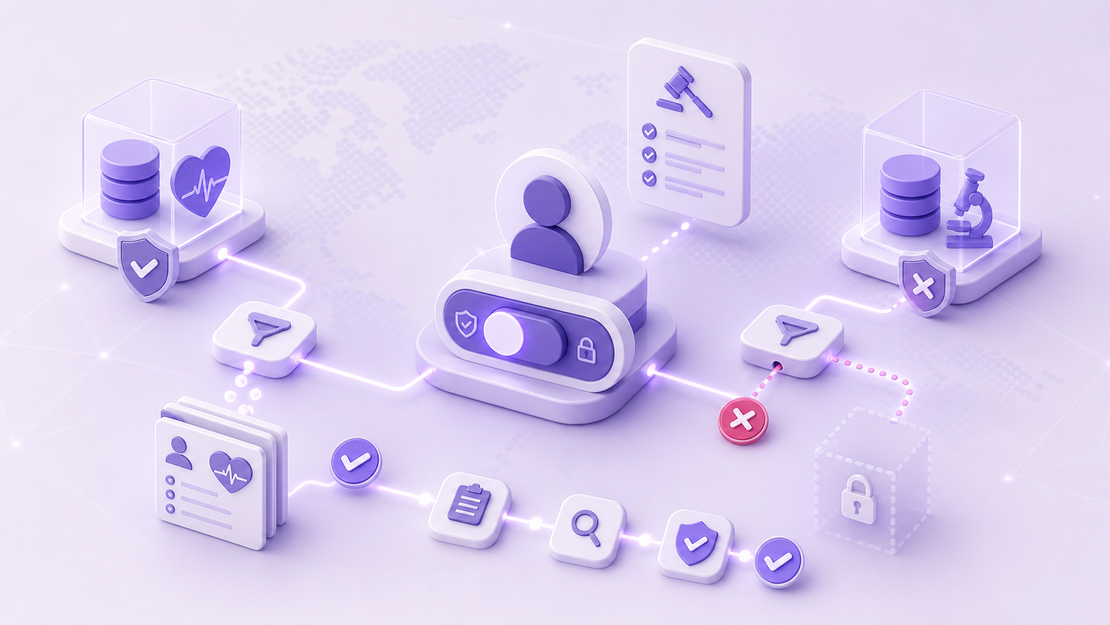
This publication explores why opt-out is not merely a consent mechanism or a UX feature, but rather a distributed policy enforcement problem.
The article analyses dynamic dataset filtering, permit-aware data assembly, timing dependencies, lineage tracking, audit requirements, and public-interest exceptions.
Particular attention is given to national implementation differences, the interaction between opt-out and secure environments, and the operational challenge of maintaining trust while preserving analytical utility.
EHDS effectively requires infrastructure capable of runtime governance enforcement, policy-aware dataset generation, and traceable lifecycle management.
The right is simple to state and hard to operate
Article 71 of Regulation (EU) 2025/327 gives natural persons the right to opt out from the processing of their personal electronic health data for secondary use. Member States must provide an accessible and easily understandable mechanism for exercising that right. Once exercised, data relating to that person must not be made available or otherwise processed under permits or requests approved after the opt-out.
The operational difficulty is that opt-out must be respected across holders, catalogues, permit workflows, dataset assembly and secure processing. It is not enough to collect a preference in one user interface. The preference must travel into the infrastructure that prepares data for use.
Exceptions require even stronger governance
The regulation allows Member States to create limited exceptions in national law, for example where public bodies or entities acting for public authorities need data for public health, official statistics, policymaking or scientific research for important reasons of public interest. But such mechanisms must be necessary, proportionate and accompanied by specific safeguards.
This means opt-out infrastructure must handle both exclusion and exceptional inclusion. That is a much harder design problem than a simple yes/no flag. It requires legal basis tracking, purpose evaluation, audit trails, and evidence that exceptions were applied only under the conditions allowed by law.
Closing thought
Opt-out will be one of the places where public trust is won or lost. If people cannot understand how their choice is respected, EHDS will face legitimacy problems. If the choice is respected through transparent, auditable infrastructure, opt-out can become a proof point that secondary use and individual rights can coexist.